Resources
STEM
Science, Technology, Engineering, and Math — sparking curiosity, building skills, and opening doors to bright futures.
What Is STEM?
STEM is an acronym for Science, Technology, Engineering, and Math. But STEM education is far more than an acronym. It’s a philosophy of education that embraces teaching skills and subjects in a way that resembles real life. STEM skills are durable skills that encourage life-long learning, critical thinking, problem-solving, and other skills that can be translated into successful careers and futures.
Why Is STEM Important?
The outlook for STEM careers is strong, with job growth projected to outpace non-STEM fields, high demand for workers, and higher median salaries. The U.S. Bureau of Labor Statistics projects STEM jobs to grow by about 10.4% between 2023 and 2033, creating millions of new positions, with the technology sector - particularly computer and information security - expected to lead the way. Wages for STEM occupations are also much higher than for non-STEM occupations, providing financial security and a pathway to independence for students from low-income communities.
Providing greater opportunities for STEM learning isn’t just about preparing the future workforce. As our world continues to rely more on technology, we all require a greater level of STEM literacy and fluency. Greater STEM literacy also helps prepare students to better understand challenges and issues that affect them and their communities.
Why STEM In Afterschool?
Research has found that students who experience the real-world relevance of STEM had 1.8 times the odds of aspiring to STEM careers at the end of high school compared with controls (Kitchen et al., 2018). It is vital that students build an identity within STEM and feel represented within the field.
Several studies highlight the importance of giving youth opportunities to engage with STEM on their own terms with the flexibility not allowed during the typical school day, showcasing how afterschool can fill this need in supporting STEM identities (Krishnamurthi et al., 2014). According to the America After 3PM survey, more than half a million Florida children participate in an afterschool program, yet a third of children still do not have opportunities to participate in STEM learning in those programs.
All students need opportunities to engage in quality STEM learning experiences. Over the last decade, afterschool programs have become a cornerstone in providing STEM learning for students from all backgrounds in all regions of the country. These programs spark students’ interest in STEM and computer science, expose them to future careers, and support school-day learning - all while developing a new generation of problem solvers.
STEM Career Maps
Careers in Space & Beyond
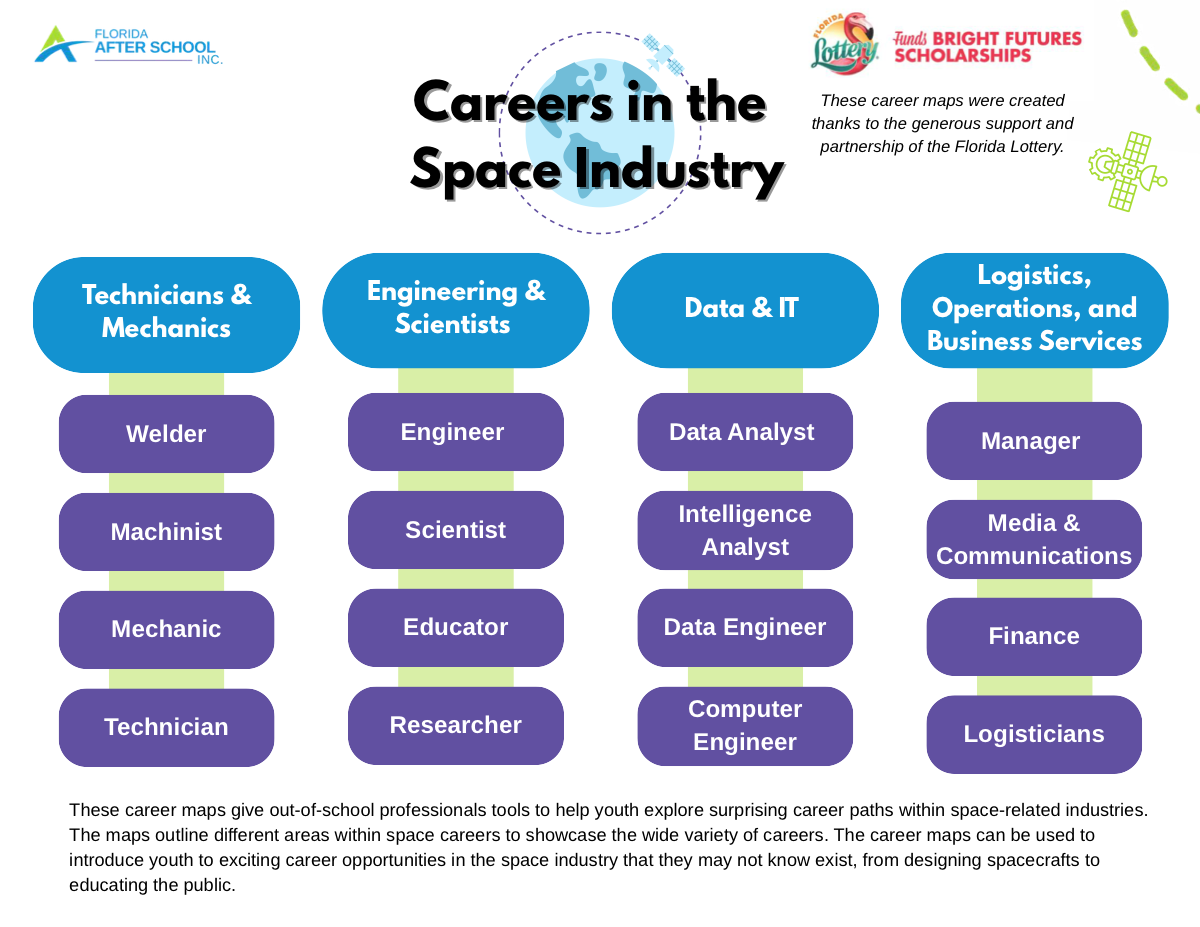
While their job is hugely impactful, there are many more careers than just astronauts within the space industry! The Florida After School Careers in Space Career Maps, brought to you by the generous support of the Florida Lottery, are designed to help you expose youth to a variety of careers in space - from technicians and mechanics, to engineers and scientists, to managers and photographers.
These maps highlight pathways and a variety of career possibilities. Download, print, and share them in your program.
Peer Learning Communities (PLCs)
Florida After School has led multiple Peer Learning Communities focused on exposing afterschool educators and professionals to STEM programming across a variety of subject areas. PLCs give groups of 5-50 afterschool professionals the opportunity to learn from like-minded peers and participate in rich professional learning on supporting STEM in their program.
Learn about PLCsFree STEM Resources & Partners
ACRES
A nationally acclaimed coaching program that builds knowledge and skills so afterschool educators can confidently facilitate STEM experiences. ACRES coaching resources are completely free and available via their website.
Visit websitehowtosmile
HOWTOSMILE brings STEM activities developed by informal science organizations to the wider educator community. Search over 4,000 of the very best STEM activities on the web.
Visit websiteMizzen Education
A free, educator-informed platform with lesson plans and activities supporting STEM, literacy, resiliency, and citizenship.
Visit websiteNASA Florida Space Grant Consortium
Established in 1989 to provide a statewide network of colleges and universities supporting Florida's space industry through grants, scholarships, and fellowships.
Visit websiteNASA Kids' Club
A safe place for children to play games and learn about NASA and its missions, with activities for pre-K through grade 4.
Visit websiteNASA's Surprisingly STEM
A video series highlighting exciting and unexpected jobs at NASA through short, accessible videos.
Visit websitePLANETS
Planetary Learning that Advances the Nexus of Engineering, Technology, and Science develops free curricula for OST programs in grades 3-8, emphasizing NASA planetary science and engineering.
Visit websiteScience Journal for Kids and Teens
Publishes an online science magazine featuring free, downloadable, peer-reviewed research papers written in kid-friendly language.
Visit websiteSTEM NEXT Opportunity Fund
Collaborates with local and state partners to spark young people's curiosity and confidence in STEM through hands-on learning beyond the classroom.
Visit websiteWFSU PBS Kids
Trusted by parents and educators, PBS Kids offers free games, apps, hands-on activities, podcasts, and other learning resources.
Visit websiteYouth Engineering Solutions (YES)
Empowers educators with high-quality PreK-8 STEM curricula and professional learning grounded in research, including career posters, free webinars, lesson plans, and more.
Visit websiteResearch
Kitchen, J. A., Sonnert, G., & Sadler, P. (2018). The impact of college- and university-run high school summer programs on students’ end of high school STEM career aspirations. Science Studies and Science Education, 102(3), 529-547.
Krishnamurthi, A., Ballard, M., & Noam, G. G. (2014). Examining the impact of afterschool STEM programs. Afterschool Alliance.